
early years… first piano.
A confluence is the place where two rivers become one. Downstream, no one can say which water came from where. That is what I have been trying to write for twenty years: music in which the classical tradition I was raised in and the improvised music I grew up loving, jazz, the music of Latin America, the long-form rock of my youth, are no longer separate currents but a single river with its own course. I call these pieces Confluents.
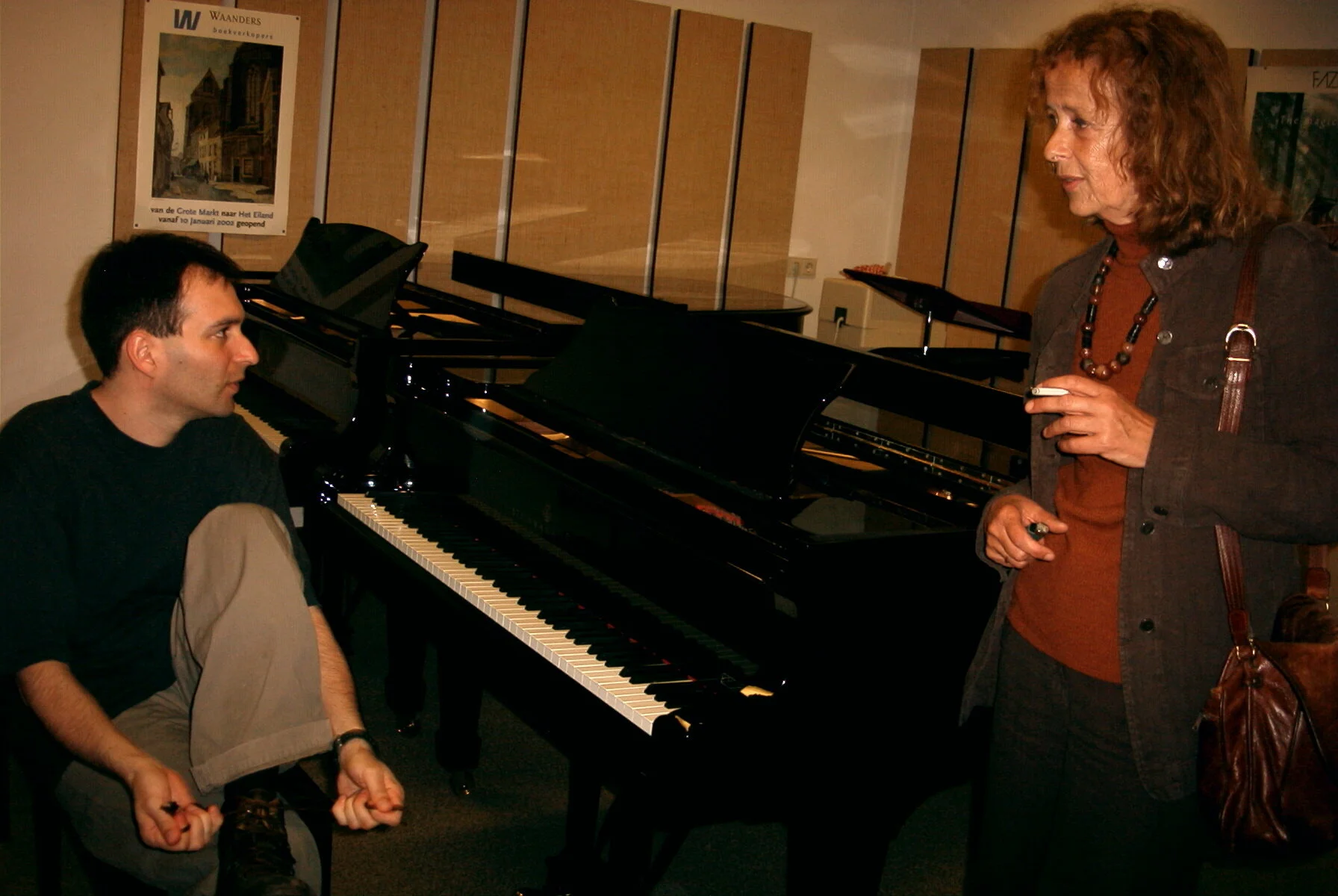
Before Recital, with piano professor Nelleke Geesink
I should say at once what this music is not. It is not an experiment in style, nor an intellectual exercise, whatever technical words like "counterpoint" further down this page may suggest. Each Confluent is written to be felt: a journey with a beginning, a road and an arrival, passing through moods that a listener should not need a programme note to recognise. It is not, I admit, the easy route. I do not set out to entertain you. I ask you to come along with an open heart; the mind will find its own way in. If the piece has done its work, it has moved you somewhere.

Prelude & Fugue for Alto Sax, tape and animation
Here is the technical heart of it. In a Confluent, improvisation is never free. It is bound to the piece, grows out of it and extends it. Often my left hand plays a part that is written note for note, while the right hand improvises above it; but that improvised line is not allowed to wander. It is made from the themes of the piece, follows its form, and answers the written part as one voice answers another in counterpoint. Sometimes an improvised passage stands against the written material as a contrast, or sits between two written sections as a bridge. Whatever its role, it is accountable to the whole. The result is that listeners rarely hear where the writing stops and the improvising begins. On a good night, neither do I.

Composing in confluential space
None of this arrived at once. Gradually, since 2007, the real work has been the language rather than any single piece: finding what the traditions have in common underneath their surfaces, and finding ways of improvising that belong to that common ground rather than to one style or another. The pieces were rewritten as the language moved on beneath them, and rewritten again for solo piano and for quartet. Behind every one of them stands a folder of hand-written sketches, additions, deletions and earlier versions. In their present form, I feel the pieces come close to what I set out to reach. For that I am grateful.

The pieces exist in two forms, and neither is a transcription of the other. At the piano alone, everything must come from ten fingers: melody, harmony, counterpoint and pulse, and the solo versions draw on the full resources of the classical piano. In the quartet, that kind of elaboration would only get in the way, so the writing changes. Bass, percussion and drums take over the pulse and widen it, a task that calls for two percussionists rather than one. The piano part, written to fit within the quartet, is free to do what it cannot do alone: to sing above a rhythm it no longer has to carry.

Post injury preparations at the Jeruzalemkerk, Amsterdam
THE ART OF THE CONFLUENT
Solo piano album · release to be announced
The first recording of these pieces is a solo piano album. I chose the title for its two meanings. It is the art of writing Confluents. And it is the art of a confluent musician, in whom these traditions fused long before he learned to write them down.
Leave your address and we'll let you know when the album is released and when concerts are announced. Nothing else, and never shared.