
early years… first piano.
Ramon Dor is a composer and pianist shaped by several musical worlds at once: the discipline of classical piano and composition, the freedom of jazz, the pulse of Latin America, the long arcs of progressive rock. Since 2007 he has been building a language in which these worlds no longer sit side by side but flow into each other, held within the forms, textures and techniques of classical music. He calls the works Confluents. The name describes the composer as much as the music.
The classical world came first, and it came from home. Both his parents were music teachers, and studying piano, harmony, counterpoint and composition was a joyful part of his childhood before it was ever a choice. The formal training followed: master's degrees in classical and in jazz piano at the Conservatorium van Amsterdam and the Messiaen Academy, and composition with Daan Manneke, whose own music moves between the old contrapuntal disciplines and the present.
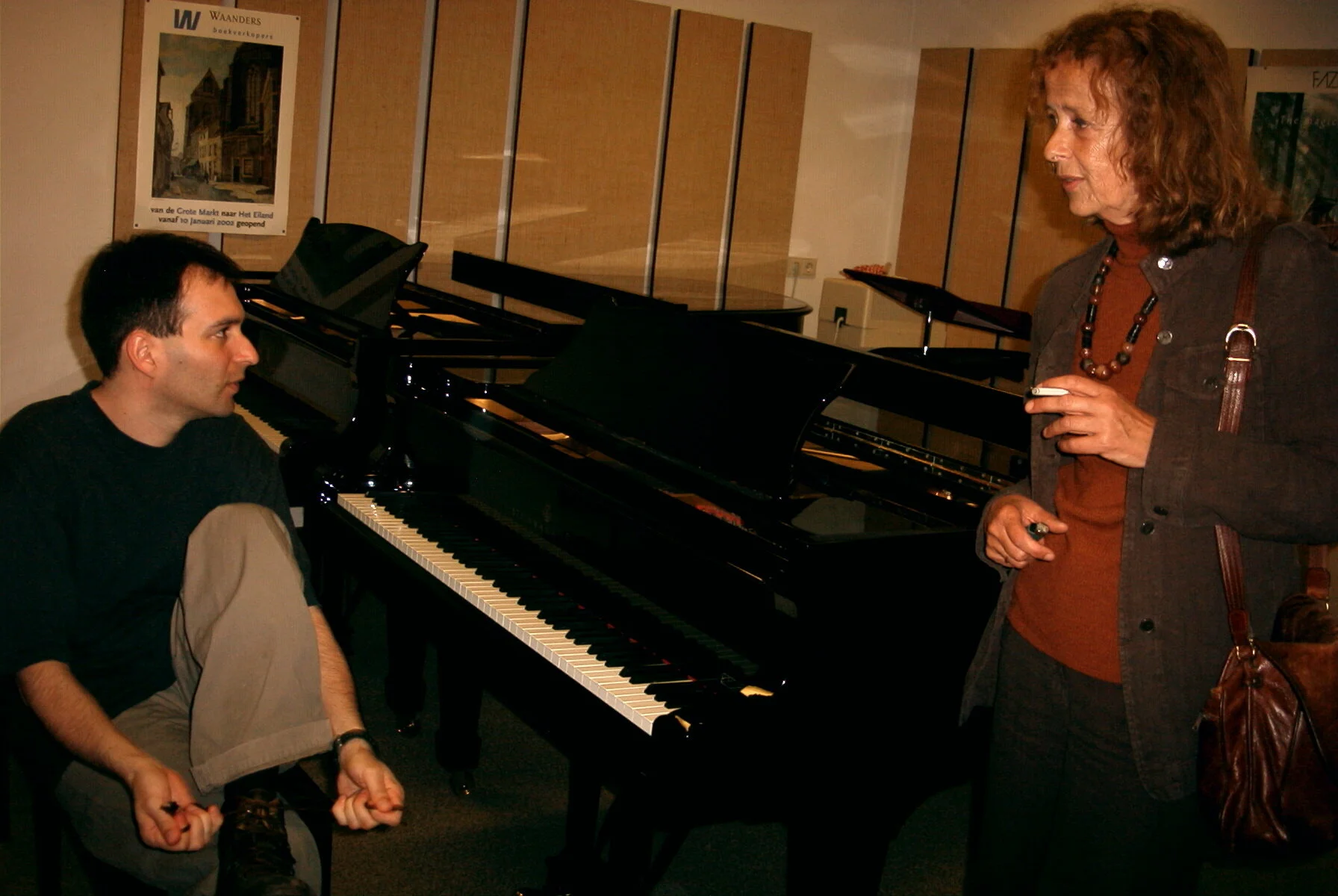
Before Recital, with piano professor Nelleke Geesink
The years that followed were full. In chamber music and with various ensembles he played the Concertgebouw, the Muziekgebouw aan 't IJ, the Bimhuis and the Prinsengrachtconcert, and was heard on Dutch radio; he wrote orchestrations for Bobby McFerrin that travelled with the singer beyond Amsterdam Sinfonietta; with violinist Davide Rossi (Coldplay) he made the first studio recording of Raymond Scott's Suite for Violin and Piano, editing and correcting the score from the composer's hand-written manuscript. Between the chamber music and the solo recitals there were long stretches in pop, rock and jazz, on stage and in the studio.

Prelude & Fugue for Alto Sax, tape and animation
And yet the composer wanted something the pianist could not give him. A musician who can move between Bach and a rhythm section is welcome everywhere, and as a performer Ramon was content to leave each world at the door of the next. But when he sat down to write, the doors were the problem. A jazz solo, however fine, arrives in a composition like a guest: it says its piece and leaves, and the emotional journey the composer had built around it goes on without it. What he was after was music in which nothing arrives from outside: where the improvised line is made of the same material as the written one, carries the same depth of feeling, and reaches the end of the piece having travelled the same road.

Composing in confluential space
Around 2007 the question changed. Not how to combine the traditions, but whether improvisation could be given a place in the architecture itself: growing from the written themes and forms, or set against them as a contrasting voice, or laid between written sections as an interlude, but always answerable to the whole. When it works, the listener cannot tell where the writing ends and the improvising begins, and has no reason to ask. Answering that question took years of experiment: fragments, then pieces, then pieces rewritten as the language changed under them. The Confluents are what came of it.

Then, in 2016, an accident with an electric saw severed the ring finger of his right hand. Amputation was advised; he chose instead the slower and less certain road of surgery, physical therapy and patience. Months passed before it was clear the finger would survive. And while the composer went on developing the language of the Confluents, the pianist began again from the beginning: scales, arpeggios, single phrases, the slow return of strength and trust to a hand that had known these things by heart. For most of a decade the stage stayed out of reach, apart from the occasional appearance.

Post injury preparations at the Jeruzalemkerk, Amsterdam
The hand came back. So, in time, did the music: twenty years of Confluents, most of them never played in public, now recorded for the first time on the solo piano album The Art of the Confluent, awaiting its release. And the stage, at last: alone at the piano, and with the Ramon Dor Quartet, where bass, percussion and drums open the music into a wider rhythmic space.